Blog
Right-Hand Drive Cars in the EU: COC and Registration
Importing a right-hand drive car into the EU? The COC alone is not enough. Here’s what inspections, modifications, and registration actually involve across the EU.
What you'll read:
The volume of right-hand drive vehicles entering the EU has increased significantly since the UK left the European single market. British-registered cars, vans, and motorcycles are attractive to buyers across the EU for several reasons: competitive pricing in sterling particularly when exchange rates are favourable, a large supply of well-maintained fleet and lease vehicles, and popular models that are harder to source in left-hand drive configuration at equivalent prices.
The appeal is real. So are the complications. A right-hand drive vehicle entering the EU registration system is not simply a standard import with an extra step. It triggers a category of regulatory scrutiny that applies to almost no other cross-border purchase, and buyers who discover this at the registration desk rather than before the purchase tend to face a combination of costs and delays that substantially erodes the price advantage that attracted them to the UK market in the first place.
Why RHD Is Different from a Standard Cross-Border Purchase
When you import a left-hand drive vehicle from Germany to any other EU country, you are moving a vehicle whose fundamental design assumptions match the road environment of the destination country. The driver sits on the correct side for the traffic flow, the headlight beam pattern illuminates the correct side of the road, and the dashboard instruments are positioned for intuitive use in left-hand traffic.
A right-hand drive vehicle designed for the UK’s left-hand traffic system does not automatically satisfy these assumptions when placed in right-hand traffic. The most immediately safety-relevant issue is headlight beam pattern. Standard right-hand drive vehicles have headlights configured to illuminate the left side of the road, which in right-hand traffic means they dip toward oncoming traffic rather than away from it. This is both a road safety hazard and a periodic inspection failure in every EU member state.
Beyond headlights, the driver’s position on the right side of the car creates practical visibility issues at right-hand traffic situations, and some EU countries require additional mirrors or other visibility aids for right-hand drive vehicles operated in right-hand traffic as a condition of registration.
What the COC Says and What It Does Not Resolve
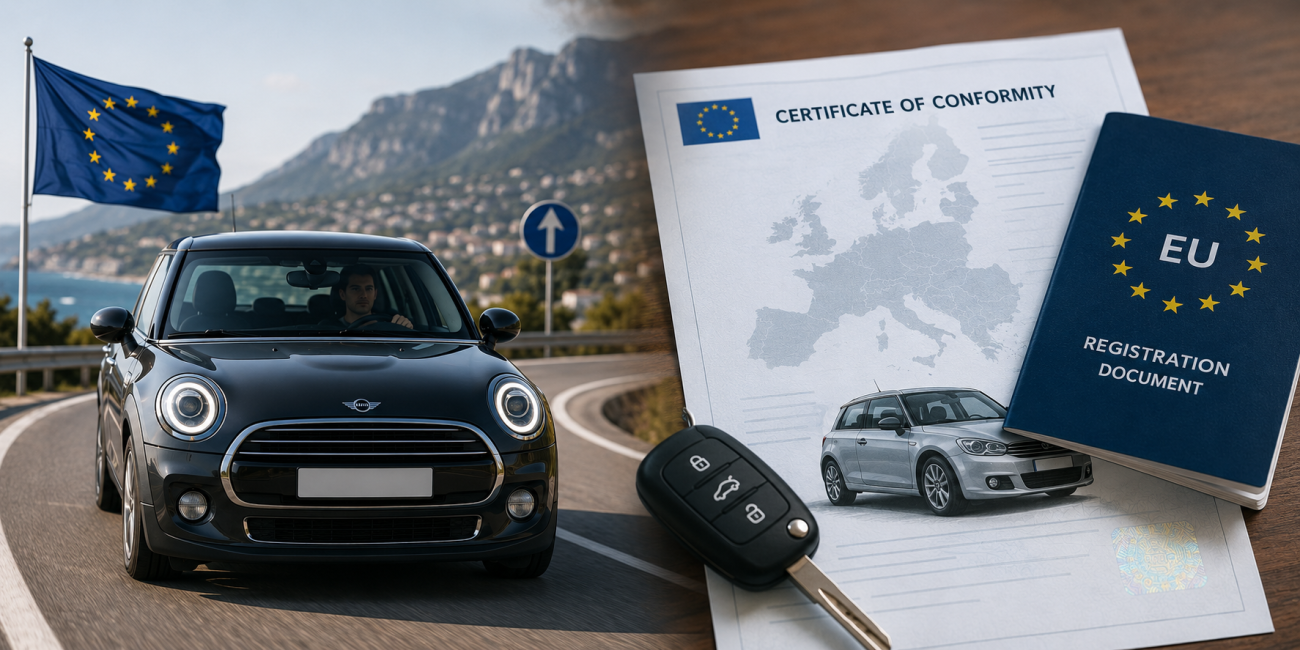
A right-hand drive vehicle that was sold through official UK market channels has a COC issued under EU type approval, or for post-Brexit vehicles under the UK’s own UKCA system. The COC confirms the vehicle’s identity and its conformity to the technical standards applicable at the time of original approval.
What the COC does not do is automatically satisfy EU registration requirements for a vehicle whose fundamental configuration is incompatible with right-hand traffic. The COC is a necessary but not sufficient document for RHD registration. It establishes the vehicle’s approved specification. What it cannot do is certify that a vehicle designed for left-hand traffic operation has been modified to operate safely in right-hand traffic.
For vehicles approved under EU type approval before Brexit, the COC is the same document you would expect for any EU-sourced vehicle. For vehicles approved under UKCA post-Brexit, the situation is more complex. UKCA approval is not EU type approval, and vehicles approved solely under UKCA after Brexit did not receive EU type approval as part of the original approval process. These vehicles may require individual technical approval in the destination EU country rather than presenting a standard COC.
Country-Specific Requirements Across the EU
EU member states share the same fundamental concern about RHD vehicles but implement their requirements with varying degrees of strictness and through varying administrative processes.
Germany requires headlight compliance and issues a specific registration pathway for RHD vehicles through the TÜV inspection system. A vehicle that passes a TÜV inspection with the appropriate RHD modifications can be registered normally. Germany does not require structural modification beyond headlights and additional mirrors in most cases, making it one of the more accessible EU markets for RHD registration.
France has historically taken a stricter approach, with DREAL regional authorities applying variable standards to RHD registrations. The requirement for an individual technical approval in addition to the standard COC is more commonly encountered in France than in Germany, and the process can be more time-consuming.
Spain and Italy both require headlight modification and may require additional modifications depending on the specific vehicle and the judgment of the individual inspection station. Neither country has a highly standardised RHD registration process, which means outcomes can vary between inspection centres even for similar vehicles.
The Netherlands and Belgium are generally considered among the more streamlined EU markets for RHD registration, with established processes at the RDW in the Netherlands and the DIV in Belgium that handle UK imports regularly due to their proximity to the UK market and the volume of cross-Channel vehicle imports.
The COC Retrieval Challenge for Post-Brexit UK Vehicles
For vehicles manufactured and sold in the UK after Brexit, the COC question is genuinely more complicated than for pre-Brexit vehicles. UK vehicles approved under UKCA after January 2021 do not carry EU type approval numbers in the standard EU format. EU registration authorities that encounter these vehicles face a document that is not in the format they are equipped to process.
Several scenarios exist for these vehicles. Some post-Brexit UK vehicles were approved through a parallel EU type approval process, particularly where the manufacturer maintained EU market operations and sought both UKCA and EU type approval simultaneously. These vehicles have EU-format COCs and can be registered in the EU through the standard process subject to the RHD modification requirements.
Other post-Brexit UK vehicles have only UKCA approval and no EU type approval equivalent. For these vehicles, individual technical approval in the destination EU country is the only pathway to registration. This involves the national vehicle authority assessing the vehicle against applicable EU technical standards on a case-by-case basis, a process that is more expensive, more time-consuming, and less predictable in outcome than standard type approval-based registration.
Before purchasing any post-Brexit UK vehicle, verify its approval status and confirm whether EU type approval exists. For vehicles with EU type approval, coc-auto.eu can retrieve the COC. For vehicles without EU type approval, the registration pathway needs to be investigated with the national authority in the destination country before the purchase is finalised.
Official Certificates of Conformity
At Auto-COC.eu, we provide official manufacturer-issued Certificates of Conformity for over 90 brands including BMW, Mercedes, Volkswagen, Audi, Toyota, Renault, Peugeot, Ford, and many more.
📩 PDF via Email
📦 FedEx/UPS Post Delivery
⏱️ Fast processing & delivery