Blog
What Is a Vehicle Type Approval Number and Why Does It Matter for Registration?
The type approval number on your COC is more important than most buyers realise. Here’s what it means, how to verify it, and what to do when something’s wrong.
What you'll read:
Every Certificate of Conformity contains a field that most buyers scan past without stopping to understand. It sits near the top of the document, formatted as a string of letters, numbers, and asterisks that looks like a reference code rather than meaningful information. This is the EU type approval number, and it is arguably the single most important piece of data on the entire COC for registration purposes.
Understanding what this number means, what it proves, and how registration authorities use it transforms the COC from a document you hand over and hope gets accepted into one you can verify, defend, and if necessary challenge. For anyone buying a vehicle across EU borders, this knowledge is genuinely practical.
What Vehicle Type Approval Actually Is
Before unpacking the number itself, it helps to understand the process it represents. EU vehicle type approval is the regulatory process by which a vehicle manufacturer demonstrates to a national approval authority that a vehicle model meets all applicable EU technical and safety standards before it can be legally sold in the European single market.
The approval is not conducted on every individual vehicle. It is conducted on a representative sample of a model variant, covering the specific combination of engine, body type, transmission, and equipment level being approved. Once the approval is granted for that variant, every vehicle produced to that specification is considered type-approved and can be sold in any EU member state.
The type approval number is the unique identifier assigned to that specific approved variant. It connects every individual vehicle bearing that approval to the full technical dossier submitted by the manufacturer and approved by the national authority. When a registration officer enters the type approval number into their system, they are accessing that dossier and verifying that the vehicle in front of them conforms to the approved specification.
How to Read the Type Approval Number
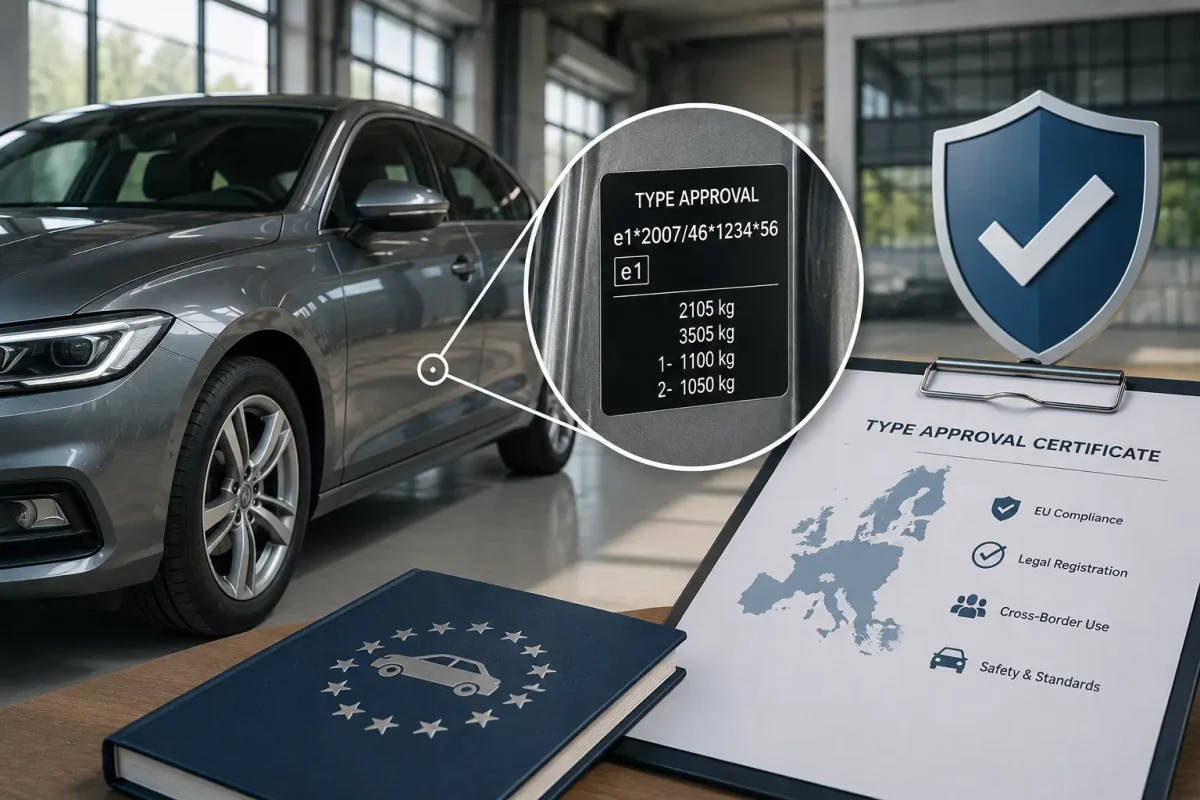
EU type approval numbers follow a defined structure that encodes specific information about the approval. Understanding the structure lets you extract meaningful information from what looks like an opaque code.
A standard EU type approval number takes a format similar to this: e1 2020/0123456 0000 00. Each element of this string has a specific meaning.
The lowercase letter e followed by a number identifies the EU member state that granted the approval. This is the country of the approval authority, not necessarily the country where the vehicle was manufactured or primarily sold. Common codes include e1 for Germany, e2 for France, e4 for the Netherlands, e9 for Spain, and e11 for the United Kingdom for approvals granted before Brexit.
The number following the country code references the EU directive or regulation under which the approval was granted. For passenger cars, this will reference either Directive 2007/46/EC for approvals granted before 2020 or Regulation EU 2018/858 for more recent approvals. For motorcycles and mopeds, the reference will be to Regulation EU 168/2013. For light commercial vehicles, the same framework as passenger cars applies under the N1 category.
The numeric string following the directive reference is the sequential approval number assigned by the approving authority. This is the unique identifier for the specific type approval dossier.
The final digits represent the extension number, indicating which variant or version of the base approval this specific configuration belongs to. A manufacturer often applies for extensions to an existing type approval when introducing variants such as a different engine option or body configuration, rather than applying for an entirely new approval.
How Registration Authorities Use the Type Approval Number
When a registration authority receives a COC for processing, one of the primary checks they perform is verifying the type approval number against their internal database or the European Commission’s type approval records system. This verification confirms two things: that the approval exists and is valid, and that the vehicle’s specifications on the COC match the specifications recorded in the approval dossier.
This check is the registration authority’s primary tool for detecting fraudulent or incorrect COC documents. A fabricated COC that contains a non-existent type approval number will fail this check immediately. A COC that contains a real type approval number but with specifications that do not match the approval dossier will also fail. And a COC that contains a real approval number belonging to a different vehicle variant than the one presented will generate a discrepancy that the authority will investigate before proceeding.
The practical implication for buyers is that the type approval number on the COC must be correct and must correspond to the specific variant of the vehicle being registered. A COC that was issued for a petrol variant of a model being presented in diesel form, or for a two-wheel-drive variant of a four-wheel-drive vehicle, will not pass registration despite the COC appearing complete and legitimate in every other respect.

When Type Approval Numbers Create Problems
Several scenarios cause the type approval number to become a registration obstacle rather than a straightforward verification step.
The most common issue for cross-border purchases is a COC that does not correspond to the specific variant of the vehicle. This can happen when a manufacturer issues a COC based on model-level records rather than VIN-specific records, resulting in a document that is technically correct for the model but not for the specific vehicle’s configuration. Buyers who receive such a document may not notice the discrepancy until the registration authority’s database check reveals it.
A second issue arises for vehicles that were originally approved under a national approval number rather than a full EU type approval. Before the current EU framework was fully established, some vehicles received national type approvals in individual member states rather than EU-wide approvals. These vehicles may have COCs that reference national approval numbers in a format that modern registration processing systems handle inconsistently across different EU countries.
A third issue specific to older vehicles involves approvals that were granted under directives that have since been repealed and whose records may no longer be accessible in the databases that modern registration authorities query. This does not mean the approval is invalid, but it can mean that the automated verification step fails and a manual review is required, adding time and complexity to the registration process.
Verifying a Type Approval Number Yourself
The European Commission maintains a publicly accessible database of EU type approvals through its CIRCABC system and through the national type approval authority of each member state. While these databases are not always consumer-friendly in their interface, they provide the underlying data that registration authorities use for verification.
For a straightforward verification, the most reliable approach is to check that the type approval number on the COC matches the approval number shown in the manufacturer’s own documentation for the vehicle’s specific variant. The manufacturer’s COC database, accessed through a service like coc-auto.eu, provides a version of the document that is issued directly from manufacturer records and carries the correct type approval reference for the specific VIN, eliminating the risk of variant mismatches that affect documents retrieved through less direct channels.
Official Certificates of Conformity
At Auto-COC.eu, we provide official manufacturer-issued Certificates of Conformity for over 90 brands including BMW, Mercedes, Volkswagen, Audi, Toyota, Renault, Peugeot, Ford, and many more.
📩 PDF via Email
📦 FedEx/UPS Post Delivery
⏱️ Fast processing & delivery
What to Do When the Type Approval Number Is Wrong or Unverifiable
If a registration authority flags a problem with the type approval number on your COC, the resolution process depends on the nature of the issue. If the number is incorrect due to a manufacturer error in the issued document, requesting a corrected COC from the manufacturer through coc-auto.eu is the fastest resolution. The platform retrieves documents directly from manufacturer databases, ensuring the type approval reference corresponds to the specific vehicle rather than a generalised model entry.
If the number references an older directive that is not readily accessible in the registration authority’s current system, providing supplementary documentation from the manufacturer confirming the approval’s validity under the referenced directive can resolve the issue. In some cases, a reissued COC under the current regulatory framework reference is the cleanest solution.
If the vehicle genuinely lacks EU type approval because it was produced before the EU framework applied or because it was imported from outside the EU without EU approval, individual technical approval is the only registration pathway, and no COC correction or retrieval will resolve this.
Frequently Asked Questions
Yes. The European Commission's CIRCABC database and individual national type approval authority databases contain type approval records. For a more accessible check, verifying the COC through a manufacturer-connected service like coc-auto.eu confirms that the document's type approval reference is correct for the specific vehicle.
Some vehicles, particularly older ones, received national rather than EU-wide type approvals. These are valid approvals but may require manual processing rather than automated verification in some countries. If your COC shows a national approval format, confirm with your registration authority how they handle this before your appointment.
A single vehicle has one type approval number corresponding to its specific approved variant. However, the same model may have multiple type approval numbers for different variants such as different engines or body types. Ensuring your COC references the number for your specific variant rather than a related but different variant is important.
No. The type approval number is assigned at the time of approval and remains associated with the vehicle regardless of which EU country it is registered in. It is a property of the vehicle's technical specification, not of its registration history.
This can happen for older approvals or approvals granted under superseded directives. Request the manufacturer to provide supplementary confirmation of the approval's validity, or obtain a reissued COC through coc-auto.eu that references the current regulatory framework. In most cases, this resolves the issue without requiring individual technical approval.
Yes. Type approval number and homologation number refer to the same thing. The term varies by country and context, with homologation being more commonly used in Southern European markets and type approval being the standard EU regulatory terminology.