
Blog
EU Vehicle Registration Certificate Explained: Every Field
What do all those fields on an EU vehicle registration certificate actually mean? This plain-English guide explains every section and why it matters for you.
What you'll read:
The EU vehicle registration certificate is one of the most important documents a vehicle owner holds, yet most people could not tell you what more than two or three of its fields actually contain. It travels with the car, gets presented at border crossings and police checks, and is the primary document establishing your legal right to operate the vehicle on public roads. When you buy a used vehicle from another EU country, understanding what the certificate contains and how its data is used in the re-registration process can save you significant time and prevent avoidable complications.
The EU partially harmonised the format of national registration certificates through Directive 1999/37/EC, which means that while each member state issues its own version of the document, a set of standardised fields and codes appear across all of them. These harmonised fields are identified by letter codes that are consistent across all EU countries, making it possible to read the essential data on a foreign registration certificate even without understanding the language it is written in.
The Two-Part Structure Used in Some Countries
Before going through the individual fields, it is worth understanding that some EU member states issue registration certificates as two separate documents rather than one. Germany is the most prominent example, issuing the Zulassungsbescheinigung Teil I as the vehicle data card that travels with the car and the Zulassungsbescheinigung Teil II as the ownership document that is kept separately.
The Teil I contains most of the technical and registration data you would expect in a single-document certificate. The Teil II functions more like a title deed, confirming ownership rather than vehicle specifications. When importing a German vehicle, you need both documents for a complete registration package in your destination country.
France previously issued the Carte Grise as a single document but has moved toward a different administrative structure through the ANTS digital system. The Netherlands issues a single Kentekenbewijs that combines all functions in one document.
Field A: Registration Number
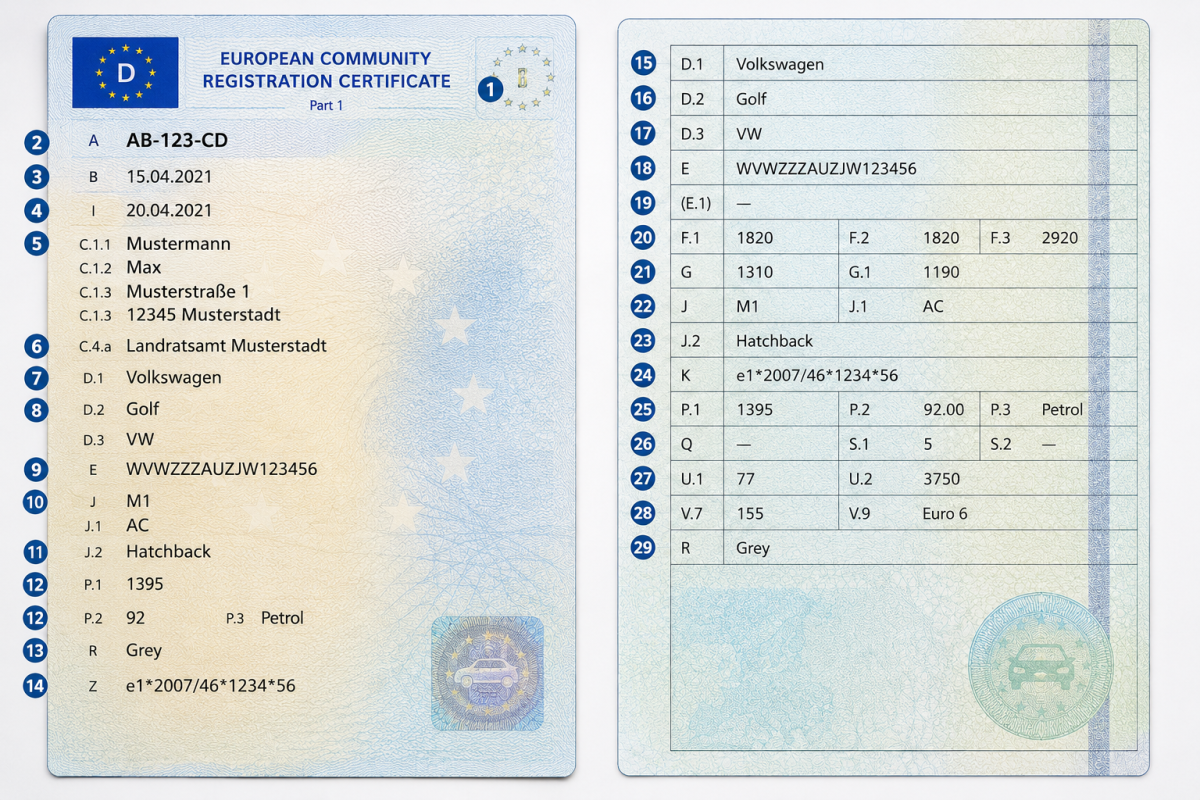
The most visible field on any registration certificate is the vehicle’s current registration number. For re-registration purposes in another EU country, this field tells you the plate number the vehicle currently carries, which should match the physical plates on the car. A mismatch between the registration number on the certificate and the plates on the vehicle is a serious discrepancy that requires explanation before proceeding with any transaction.
Field B: Date of First Registration
This field records the date on which the vehicle was first registered anywhere, including in its country of manufacture or first sale. This date is important for several registration-related purposes including calculating vehicle age for road tax bands, determining which emissions standards apply to the vehicle, and establishing the starting date for any age-based restrictions or privileges such as historic vehicle status.
Note that field B records the first registration ever, not the first registration in the current country. A vehicle that was first sold in Germany in 2019 and later re-registered in Belgium will show 2019 as the field B date on the Belgian certificate, correctly reflecting the vehicle’s actual age rather than the date of Belgian registration.
Field C: Registered Owner Information
Field C covers the owner information, typically subdivided into C.1 for the registered owner’s name and surname or company name, C.2 for the owner’s address, and C.3 for the date from which the current owner’s registration has been in effect. For re-registration purposes, verifying that the seller’s name on the certificate matches their identity documentation is an essential fraud prevention step.
In some EU countries, the registered owner and the vehicle user are distinguished, with separate entries for a leaseholder or fleet operator as the owner and an individual as the registered user. Understanding which category the person you are buying from falls into matters for the ownership transfer process.
Field D: Vehicle Identification Information
The D fields cover the vehicle’s make, model, and commercial description. D.1 is the manufacturer name, D.2 is the type approval type designation as it appears in the manufacturer’s records, and D.3 is the commercial name or model name as used in marketing. These fields allow cross-referencing against the COC to verify that the registration certificate and the conformity document describe the same vehicle.
Field E: The VIN
Field E contains the Vehicle Identification Number, the 17-character code that uniquely identifies the specific vehicle. This is the single most important field for cross-referencing purposes. The VIN on the registration certificate must match exactly, character by character, with the VIN on the COC, the VIN on the purchase documentation, and the VIN physically present on the vehicle. Any discrepancy in any character is a serious problem requiring resolution before the transaction proceeds.
Field F: Mass Information
The F fields cover the vehicle’s mass data. F.1 is the maximum technically permissible laden mass, which is the maximum gross weight the vehicle can legally operate at including passengers, cargo, and fuel. F.2 is the permissible maximum laden mass of the vehicle in service in the registering country, which may differ from F.1 in some national implementations. F.3 covers the maximum permissible laden mass of the combination where the vehicle is used as a towing vehicle.
Field G: Mass of the Vehicle in Service
Field G records the mass of the vehicle in service, meaning its kerb weight as equipped for road use. This figure appears on the COC and should match. Significant discrepancies between the registration certificate’s G field and the COC kerb weight figure can indicate that the vehicle has been substantially modified or that one of the documents is incorrect.
Field H: Period of Validity
Field H records the period of validity of the registration. In most EU countries, registration does not expire and the H field is left blank or marked as unlimited. In countries where registration is issued for defined periods, this field specifies when renewal is required. For imported vehicles, understanding whether the current registration has a validity period that affects the transition to the new country’s registration system is relevant to timing the re-registration process.
Field I: Date of Registration in the Current Country
Unlike field B which records the first-ever registration, field I records the date of registration specifically in the country that issued the current certificate. For a vehicle that has been re-registered multiple times across different EU countries, field I reflects only the most recent national registration, while field B continues to reflect the original first registration date.
Field J: Vehicle Category
Field J records the EU vehicle category code. For standard passenger cars this will be M1. For light commercial vehicles it will be N1. For motorcycles it will be one of the L sub-categories. This field allows quick verification that the vehicle is being registered under the correct category, which affects applicable tax rates, emission zone access, and other category-specific regulatory treatment.
Fields K Through P: Technical Specification Fields
The remaining technical fields cover engine and performance data in a standardised format. Field K is the type approval number, the same number discussed in the separate article on type approval. Field L is the number of axles. Field O covers towing capacity. Field P.1 is the engine displacement in cubic centimetres. Field P.2 is the maximum net power in kilowatts. Field P.3 is the fuel type code, with standardised codes including GA for petrol, GO for diesel, EL for electric, and various codes for hybrid configurations. Field P.5 is the engine identification number as stamped on the engine block.
Field S: Seating Capacity
Field S records the seating capacity, with S.1 being the number of seats including the driver and S.2 being the number of standing places where applicable. For passenger car buyers this is straightforward. For commercial vehicle buyers or anyone purchasing a vehicle with conversion history, verifying that the seating capacity on the registration certificate matches the physical configuration of the vehicle is important.
Using the Registration Certificate for Cross-Border Re-Registration
When you present a foreign registration certificate to your national authority as part of a re-registration application, they will use the harmonised field codes to extract the data they need regardless of the language the rest of the document is in. The letter codes are consistent across all EU member states specifically to enable this cross-border legibility.
The fields they will focus on most carefully are E (VIN), B (first registration date), J (vehicle category), K (type approval number), and the P fields for engine specification. These will be cross-referenced against the COC and against their own database records. Ensuring that all of these fields are consistent across every document in your registration package eliminates the most common sources of processing delay.
For COC retrieval to support the re-registration process, coc-auto.eu provides manufacturer-sourced documents that contain all the correct field data for the specific vehicle identified by VIN.
Who Should Use auto-coc.eu
You do not need to be in an unusual situation to benefit from using auto-coc.eu. The platform is the right choice if:
- You bought a used car, motorcycle, or scooter from another EU country and the seller did not provide the COC
- Your original COC was lost and you need a replacement before your registration appointment
- The dealer quoted you an unreasonable fee and you want a faster, cheaper alternative
- You are working against a registration deadline and cannot afford to wait weeks for a manufacturer to respond
- You want to confirm COC availability before finalising a vehicle purchase
Whether you were hoping for a free COC online or simply want to stop overpaying, the platform offers transparent pricing upfront — no surprises, no hidden fees, no wasted trips to a dealership.
Official Certificates of Conformity
At Auto-COC.eu, we provide official manufacturer-issued Certificates of Conformity for over 90 brands including BMW, Mercedes, Volkswagen, Audi, Toyota, Renault, Peugeot, Ford, and many more.
📩 PDF via Email
📦 FedEx/UPS Post Delivery
⏱️ Fast processing & delivery