Won a Car Auction? Here’s What Paperwork to Ask For


Won a Car Auction? Here's What Paperwork to Ask For
Just won a car at auction? Don’t celebrate yet. Here’s the exact paperwork you need to register it legally — including why the COC is non-negotiable.
What you'll read:
Winning a car at auction feels great, right up until the moment you realise the vehicle comes with a stack of documents you have never dealt with before, some of which may be incomplete, missing, or written in a language you do not speak. Whether you bid through a physical auction house in Germany, an online platform like BCA, Copart, or ADESA, or a local dealer auction closer to home, the paperwork you walk away with will determine how smoothly, or painfully, the registration process goes.
This guide covers every document you should request immediately after winning, why each one matters, and what to do when something is missing before you have already paid transport costs to bring the car home.
Why Auction Paperwork Is More Complicated Than a Private Sale
In a standard private sale between two individuals, the seller typically hands over the registration certificate, the service history, and any other documents the car has accumulated over its life. There is a direct line of communication, and if something is missing, you can follow up with one person.
Auction houses operate differently. Once the hammer falls, the auction house’s responsibility is largely limited to transferring legal ownership. They are not in the business of chasing down missing technical documents on your behalf, and in many cases they have received the vehicle from a fleet company, leasing operator, or insurer with only the minimum documentation required to conduct the sale. The burden of identifying what is missing and obtaining it falls on you as the buyer.
This is especially true for cross-border auction purchases, which have become the norm for Romanian, Hungarian, Bulgarian, and Polish buyers shopping in Western European markets.

Document 1: The Title or Registration Certificate
The most fundamental piece of car auction paperwork is proof of ownership — the vehicle’s registration certificate, known by different names across EU countries. In Germany this is the Zulassungsbescheinigung Teil II (the ownership document, distinct from the vehicle data card). In France it is the Carte Grise. In Belgium, the Certificat d’Immatriculation.
Without this document, you cannot prove the vehicle is legally yours, and no registration authority will process your application. Confirm before bidding whether the title is present and clean — a salvage title, a finance marker, or a missing ownership document are all serious complications that can take weeks to resolve and in some cases cannot be resolved at all without costly legal intervention.
Document 2: The Certificate of Conformity
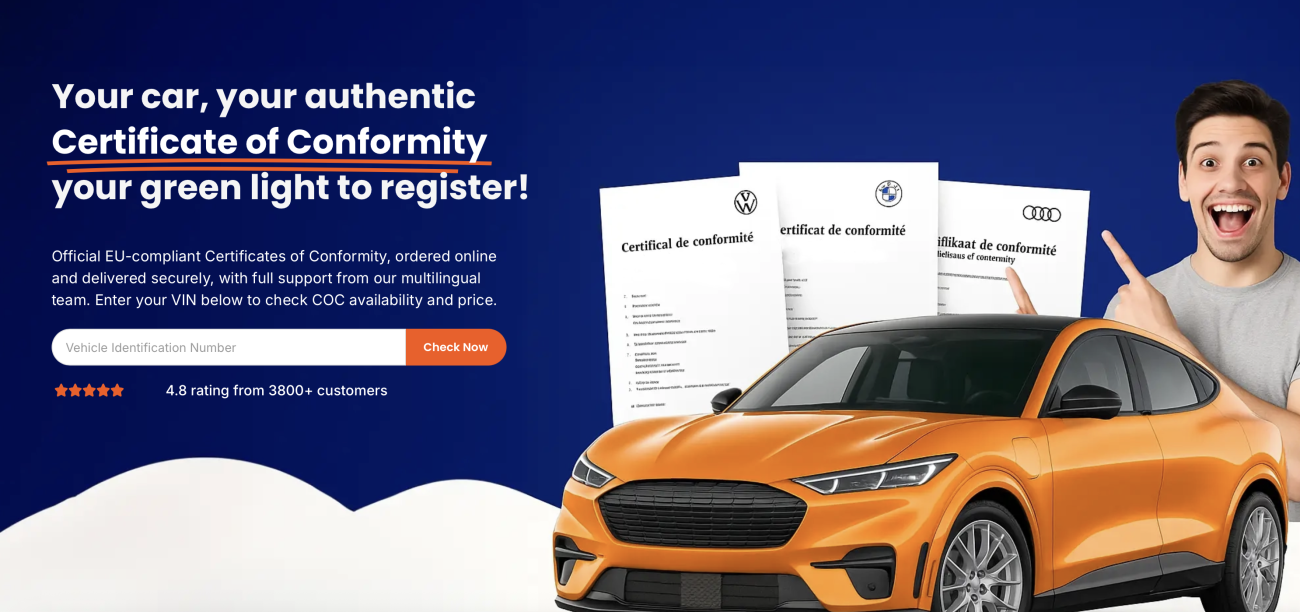
This is the document that catches the most auction buyers off guard. The Certificate of Conformity is the EU-issued technical passport that proves your vehicle meets European type approval standards. It is required for registration in any EU member state, and auction houses very rarely include it automatically in the car auction paperwork package.
Fleet operators and leasing companies – who supply a large proportion of vehicles to European auctions – often retain or discard the COC after original registration, since they have no further use for it. This means you may win a perfectly roadworthy, well-documented car and still find yourself unable to register it because this single document is absent.
Ask the auction house explicitly before or immediately after winning: is the COC present? If the answer is no, do not panic, but do act quickly. Platforms like auto-coc.eu specialise in retrieving COCs directly from manufacturer databases for vehicles across all major makes and models. Submitting your VIN through the platform is faster and cheaper than going through the manufacturer directly or paying a dealership to handle the request on your behalf.
The COC is non-negotiable. Without it, your only alternative is individual technical approval through RAR or your national equivalent, a process that costs significantly more and takes considerably longer than simply obtaining the document through the right channel from the start.
Document 3: The Service History and Maintenance Records
Service history is not legally required for registration, but its absence has real consequences for the vehicle’s value, insurance classification, and your ability to identify potential mechanical issues before they become expensive problems. Full car auction paperwork should include stamped service booklets, digital service records printed from the manufacturer’s system, or at minimum invoices from authorised workshops showing scheduled maintenance was carried out.
For premium brands a verified service history significantly affects resale value. If the auction listing described the car as having full service history and the physical documents are not present at collection, this is a legitimate dispute you can raise with the auction house before leaving the premises.
Get a Full carVertical Report
The same comprehensive data. A better price — exclusively through COC-Auto.
Document 4: The MOT or Technical Inspection Certificate
Every EU country has its own periodic technical inspection system. Germany has the TÜV, France has the Contrôle Technique, Belgium the Contrôle Technique/Keuring, and Romania has the ITP. When buying at auction, the current inspection certificate tells you two things: the vehicle passed a technical inspection at a specific date, and the recorded mileage at that point is documented officially.
A valid inspection certificate from the country of origin does not exempt you from obtaining a Romanian ITP for registration purposes, but it provides valuable baseline information about the vehicle’s condition and history. If the certificate is missing from the car auction paperwork, request it from the auction house — they are usually able to supply a copy if one existed.
Document 5: The Customs Declaration (for Non-EU Vehicles)
If you have won a vehicle at a salvage auction that imports cars from the United States, United Kingdom, or Japan — as platforms like Copart and IAAI regularly do — there is an additional layer of documentation to address. Vehicles originating outside the EU require a customs clearance document proving that import duties and VAT have been paid upon entry into the European single market.
Without this document, your car auction paperwork is incomplete in a way that no COC retrieval service can fix. Custom duties must be settled before registration can proceed, and the amounts involved can be substantial — sometimes reaching 10–20% of the vehicle’s declared value on top of the purchase price. Always confirm the customs status of any non-EU origin vehicle before bidding.

Document 6: The Auction House Sale Invoice
This one sounds obvious, but it is worth stating explicitly. The auction house invoice is your proof of purchase and the document that establishes the legal chain of ownership from the previous registered keeper to you. It should include the vehicle’s VIN, the sale price, the date of transaction, and the auction house’s legal details.
Some buyers treat this as a formality, but registration authorities and insurance companies may ask for it — particularly when the vehicle is coming from a foreign auction and the ownership chain needs to be clearly established. Keep it with the rest of your car auction paperwork throughout the registration process.
What to Do If Documents Are Missing After You Have Paid?
The ideal moment to identify missing paperwork is before the transaction is finalised. The realistic moment is usually after you have already paid and are standing at the collection desk realising something is not right. If you find yourself in this position, here is the order of priority.
Title missing: raise it immediately with the auction house — this is their responsibility to resolve and most reputable platforms have a process for it. COC missing: go directly to auto-coc.eu, enter your VIN, and initiate a retrieval request. This is the fastest route to the document and will cost you a fraction of what a dealership would charge. Service history missing: contact the manufacturer’s authorised network with the VIN — they can often print a digital service record even if the physical booklet is gone. Inspection certificate missing: less critical, but worth requesting from the auction house’s administrative team before departure.
The Bottom Line on Car Auction Paperwork
Winning a vehicle at auction is only the first step. What you do in the hours and days immediately after the hammer falls determines whether your purchase becomes a smooth registration or a prolonged administrative headache. The car auction paperwork checklist is not long, but every item on it matters — and the COC is the one that most buyers underestimate until they are standing at a registration authority without it.
Check for it before you collect. If it is missing, retrieve it through auto-coc.eu before your vehicle even arrives home. A few minutes of preparation at this stage saves weeks of frustration later.
Official Certificates of Conformity
At Auto-COC.eu, we provide official manufacturer-issued Certificates of Conformity for over 90 brands including BMW, Mercedes, Volkswagen, Audi, Toyota, Renault, Peugeot, Ford, and many more.