Buying a Car from Germany: The Complete Import Checklist (2026 Guide)

Buying a Car from Germany: The Complete Import Checklist (2026 Guide)
This complete checklist for buying a car from Germany in 2026 covers every step of the process, from the moment you find a vehicle online to the day it is legally registered in your name at home. Follow it in order and your import will go smoothly. Skip a step and you will almost certainly regret it.
What you'll read:
The German used car market remains the largest and most liquid in Europe in 2026. Supply is vast, competition among sellers keeps prices honest, and German buyers are known for meticulous vehicle maintenance and accurate service documentation. When buying a car from Germany, you are far more likely to find a car with a full, verifiable service history than in most other markets. That reliability is a core part of the value proposition.
Beyond quality, the sheer variety of buying a car from Germany is unmatched. Whether you want a BMW, Mercedes-Benz, Volkswagen, Audi, Porsche, or any non-German brand in excellent condition, the German market offers options that simply do not exist at the same price point in most other European countries. For buyers in Eastern Europe, the Balkans, and the broader EU, buying a car from Germany continues to represent one of the best value-for-money decisions in the automotive world.
Before You Buy: Essential Checks When Buying a Car from Germany
Run a Vehicle History Check Before Buying a Car from Germany
Before any money changes hands, run a thorough vehicle history check on the car you are considering. In Germany, services such as the ADAC vehicle history report, Carfax, and carVertical provide detailed records including previous owners, mileage readings, accident history, theft records, and outstanding finance. When buying a car from Germany, a clean history report is not optional — it is the foundation of a safe purchase.
Pay particular attention to mileage consistency across multiple service stamps and MOT records. Germany has an excellent culture of documented maintenance, so a car with gaps in its service history is a red flag. Cross-reference the VIN on the vehicle against all documents — the chassis plate, the Zulassungsbescheinigung, and the service book — before signing anything.
Get a Full carVertical Report
The same comprehensive data. A better price — exclusively through COC-Auto.
Inspect the TUV and Vehicle Condition When Buying a Car from Germany
The TUV (Technischer Uberwachungsverein) inspection is Germany’s roadworthiness test, similar to the MOT in the UK or ITV in Spain. When buying a car from Germany, always check the remaining validity of the TUV sticker on the rear number plate. A freshly passed TUV is a strong indicator of vehicle condition and significantly reduces the risk of costly repairs immediately after purchase.
If you cannot visit Germany in person to inspect the vehicle — which is common when buying a car from Germany remotely — commission an independent inspection from a local ADAC representative or a specialist vehicle inspection service. Many operate across Germany and will provide a detailed report with photographs for a fixed fee. Never buy a car from Germany unseen without an independent inspection report in hand.

The Complete Import Checklist for Buying a Car from Germany in 2026
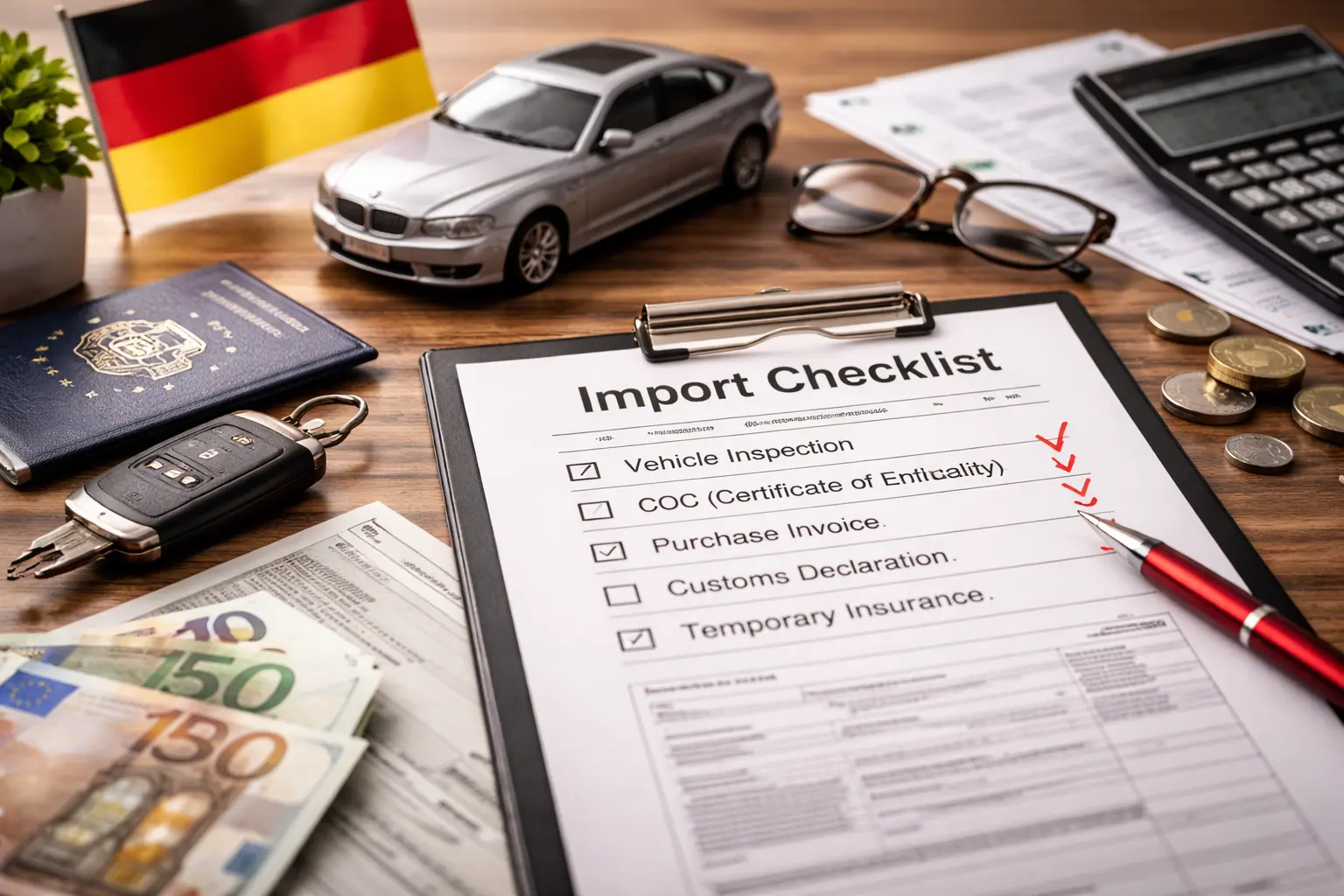
The table below is your master reference for every document, task, and action required when buying a car from Germany. Keep this list with you throughout the process:
The COC: The Most Critical Document When Buying a Car from Germany
The Certificate of Conformity (COC) is the official manufacturer document certifying that your vehicle meets all applicable EU technical and emissions standards. When buying a car from Germany, the COC is mandatory for registration in every EU member state. It contains your vehicle’s VIN, engine specifications, emissions data (including Euro standard and CO2 g/km), dimensions, and the European type-approval number. Without it, no registration authority will process your application.
The problem many buyers encounter when buying a car from Germany is that the previous owner may have lost the COC, or the dealership may not have it on file for older vehicles. In these cases, the fastest and most affordable solution is to order a replacement COC through coc-auto.eu.
The platform accesses BMW, Mercedes-Benz, Volkswagen, Audi, and all other major manufacturer databases directly and delivers an authentic, legally valid COC, from just EUR 115. It is the essential tool for anyone buying a car from Germany who needs documentation sorted quickly.
Need a COC When Buying a Car from Germany? coc-auto.eu Has You Covered.
Europe's leading platform for Certificate of Conformity retrieval.
Official COC in 5-15 business days via VIN.
Covers all major brands (BMW, MB, VW, Audi, Porsche, etc.).
Prices from 115€ — up to 70% cheaper than dealers.
Accepted by registration authorities in all EU member states.
Free VIN check available before you order.
The Kaufvertrag: Getting the Purchase Contract Right When Buying a Car from Germany
The Kaufvertrag is the German purchase contract — the document that legally transfers ownership of the vehicle from seller to buyer. When buying a car from Germany, always insist on a properly completed Kaufvertrag signed by both parties. It must include the full details of the vehicle (make, model, year, VIN, mileage, registration number), the agreed purchase price, the payment method, the date of handover, and a declaration by the seller that the vehicle is free of outstanding finance, liens, or legal encumbrances.
Keep at least two original signed copies of the Kaufvertrag — one for yourself and one for submission to your home country registration authority.
PRO TIP
When buying a car from Germany as a private individual from a private seller, it is also advisable to include a clause stating the vehicle was sold without warranty (wie besichtigt und gefahren — as seen and driven), which is standard practice in German private sales and protects both parties from disputes after handover.
Transport and Insurance: Moving Your Car After Buying a Car from Germany
Export Plates When Buying a Car from Germany
If you plan to drive the vehicle home yourself after buying a car from Germany, you will need export plates (Ausfuhrkennzeichen). These temporary plates are issued by a German registration office (Zulassungsstelle) or an approved vehicle dealer and are valid for a fixed period — typically up to 30 days. They allow you to legally drive the vehicle from Germany to your home country and cover mandatory third-party liability insurance for that journey.
Alternatively, if you are transporting the vehicle on a trailer or car transporter, export plates may not be required. However, you must ensure the transporting vehicle has valid insurance that covers the load. When buying a car from Germany via a transport company, confirm in writing that they carry appropriate cargo liability insurance before handing over the vehicle.
Insurance When Buying a Car from Germany
Driving a vehicle with export plates requires at minimum third-party liability insurance, which is typically included in the export plate package from the issuing office. However, this is minimum coverage only. When buying a car from Germany, particularly a high-value vehicle, consider arranging comprehensive transit insurance separately to protect against theft or damage during the journey home.
Upon arriving in your home country, arrange local insurance immediately — before your export plate period expires. In most EU countries, you cannot complete registration without proof of a valid local insurance policy. Planning this in advance, rather than after arrival, is one of the simplest ways to avoid delays when buying a car from Germany.

Understanding the Full Cost of Buying a Car from Germany in 2026
The purchase price is only the starting point when buying a car from Germany. Budgeting accurately for all associated costs prevents unpleasant surprises. The table below outlines the typical additional costs involved:
When buying a car from Germany, the total additional cost beyond the purchase price typically falls between EUR 500 and EUR 1,500 for an EU buyer, depending on the destination country and whether transport is required. Factoring these costs in before negotiating the purchase price ensures your budget is accurate from the start.
| Cost Item | Typical Amount | Notes |
|---|---|---|
| Vehicle history check | EUR 10 – 30 | Carfax, ADAC, carVertical |
| Independent inspection | EUR 100 – 200 | ADAC or specialist service |
| Certificate of Conformity (COC) | From EUR 115 | coc-auto.eu — fastest option |
| Export plates + insurance | EUR 50 – 150 | From German Zulassungsstelle |
| Transport (if not self-drive) | EUR 200 – 800 | Varies by distance and vehicle |
| VAT / customs (non-EU buyers) | Variable | Not applicable for EU buyers |
| Home country registration fees | EUR 50 – 300 | Varies by country |
| National roadworthiness test | EUR 50 – 150 | ITV, MOT, RAR, etc. |
Frequently Asked Questions: Buying a Car from Germany
Yes, in virtually all cases. When buying a car from Germany and registering it in any EU member state, the Certificate of Conformity is a mandatory registration document. If the seller cannot provide one, order a replacement immediately.
Do not make the mistake of transporting a vehicle home without confirming the COC situation first. Discovering the document is missing later adds both cost and delay to the process.
Yes, provided you follow the correct due diligence steps. German sellers are known for accurate documentation, and the market is well-regulated. Risks like odometer fraud are easily mitigated with a history report and independent inspection.
The most important protection is documentation: a clean history report, a proper Kaufvertrag, a valid COC, and a current TUV sticker.
Yes. Remote purchases are common. You can successfully complete purchases using services like ADAC inspection, digital Kaufvertrag signing, and electronic COC retrieval through auto-coc.eu.
Avoid paying the full amount before inspection. A reasonable deposit to hold the car is standard practice and protects both parties.
Registration timelines vary by country, but once you have all documents (COC, Kaufvertrag, insurance), it typically takes one to two weeks.
The bottleneck is almost always documentation: a missing COC is the most common cause of registration delay.
Within the EU, there are no customs duties. VAT depends on whether the vehicle is new/used and the seller's status (private vs dealer).
Buyers outside the EU (UK, Switzerland, etc.) must account for import duties and local VAT. Check with your local customs authority for rates.
The dominant platforms are Mobile.de and AutoScout24. Always use official platforms rather than social media listings for better verification.
Remember to factor in all costs: inspection, COC retrieval via auto-coc.eu, export plates, and transport before deciding.
The Bottom Line
Buying a car from Germany in 2026 is one of the smartest moves any European car buyer can make, but only if the process is handled correctly. The vehicle selection is unmatched, the pricing is competitive, and the documentation culture is excellent. Follow the checklist in this guide, never skip the COC step, and make sure every document is in order before the vehicle leaves Germany.
The one tool that makes buying a car from Germany significantly easier is auto-coc.eu. Whether the seller has the COC or not, auto-coc.eu provides a fast, affordable, and legally valid replacement, removing the single most common documentation obstacle in the entire import process. Visit www.coc-auto.eu as part of every purchase you make when buying a car from Germany.
Ready to Check?
Enter any VIN at COC-Auto and get the full carVertical report — accidents, mileage, theft, finance, and more.
Check a VIN for €19.99 →€10 cheaper than buying direct from carVertical
Disclosure: COC-Auto is an authorised affiliate of carVertical. When you purchase a report through our links, we receive a commission at no additional cost to you — in fact, you pay less than you would directly. We only recommend services we genuinely use and stand behind.